- Cosmetic Dermatology
Sclerotherapy
Fade spider veins for smooth, clear legs
A simple injection treatment that fades unwanted spider veins on the legs.
Board-certified dermatologist Dr. Craig Singer performs sclerotherapy for spider veins at his Bingham Farms practice.
Quick facts
Treats
Leg spider veins
Procedure
Downtime
Minimal
Sessions
Often a few
Results
Fade over weeks
Aftercare
Compression often worn
What is sclerotherapy?
Sclerotherapy is a time-tested treatment for spider veins, the small red, blue, or purple veins that commonly appear on the legs. A solution is injected directly into the vein, causing it to collapse and gradually fade from view as the body absorbs it. Treatment is quick, performed in the office, and requires little downtime.
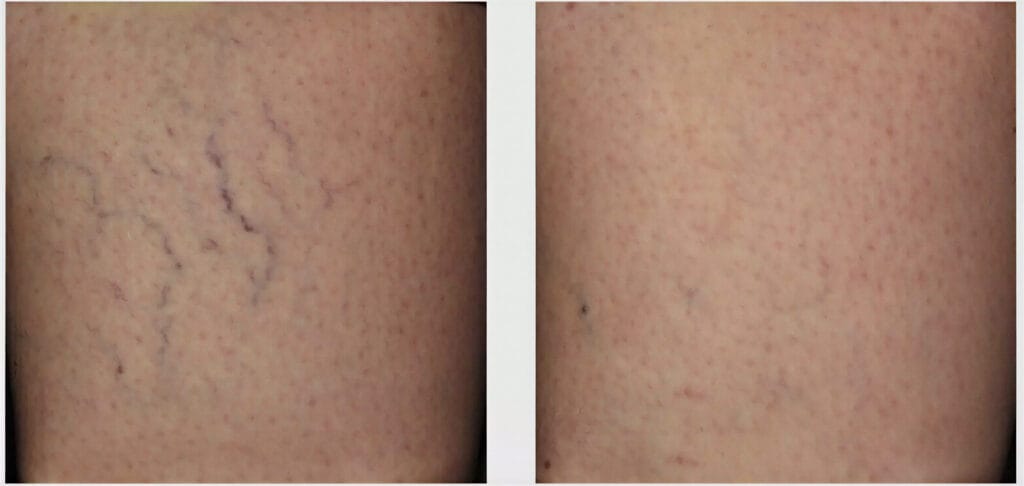
Sclerotherapy is the treatment of choice for eliminating “spider veins” (superficial telangiectasias) and small reticular veins (1-2mm in diameter). The treatment is minimally invasive. Polidocanol (Asclera™) is the primary sclerosing agent used at Craig Singer MD Dermatology. When Polidocanol is injected into the vein, the wall of the vein becomes irritated and inflamed leading to vessel wall breakdown. The injured vein is then removed by the body’s own healing mechanism over the several weeks to months, and eventually fades. Bloodflow is then rerouted through healthier veins.
A simple, proven treatment
Several veins can be treated in a single visit. Most people wear compression stockings for a short period afterward and return to their normal activities right away.
What do "Spider Veins" look like?
What sclerotherapy treats
Sclerotherapy targets unwanted surface veins on the legs:
Leg spider veins
The classic web-like veins on the legs.
Small surface veins
Fine red and blue veins near the surface.
Cosmetic leg veins
Veins that bother you cosmetically.
Clusters of vessels
Treating several at once.
Benefits of sclerotherapy
A straightforward, effective option:
Quick in-office visit
Treatment takes only a short time.
Minimal downtime
Return to normal activity right away.
Proven & time-tested
A long-established treatment.
Several veins per visit
Efficient, focused sessions.
Frequently Asked Questions (FAQ)
What sclerotherapy treats, how it works, comfort, downtime, sessions, and aftercare.
What types of veins do you treat with sclerotherapy?
We treat spider veins (“superficial telangiectasias“) and reticular veins (1-2mm in size).
Do you treat larger varicose veins with sclerotherapy?
No. Larger varicose veins (>3mm) require micophlebectomy or foam sclerotherapy.
How many sessions will I need?
The number of treatments differs from patient to patient, depending on the extent of spider veins present. One to six treatments may be needed; The average is three to four.
How long does it take to see results?
The process of collapse and disappearance of veins (i.e. vascular sclerosis) continues for 4 to 6 weeks after polidocanol injection. Each vessel requires 2 to 3 injections with gradual disappearance occurring over 2 to 3 months. If widespread superficial veins are present, however, it may take a year to achieve acceptable cosmetic results.
Does sclerotherapy prevent the formation of new spider or reticular veins?
No it does not. New veins may form months to years after injection, possibly requiring maintenance treatment.
Does sclerotherapy work for everyone?
Most people treated will have “good results” (50-80% clearance); however, there is no guarantee that sclerotherapy will be effective in every case. Multiple sclerotherapy sessions are usually needed to achieve “good results.” It is not realistic to expect every vein to disappear completely, without a trace. Also, your body may produce new spider veins over time, and therefore you may need maintenance treatments in the future.
Approximately 10% of patients who undergo sclerotherapy have poor to fair results (This means there is only minimal improvement after six treatments). In very rare instances, the patient’s condition may become worse after sclerotherapy treatment.
What are the most common side effects of sclerotherapy?
- A slight burning sensation may be noted initially during injection along with some mild swelling / “hive -like” lesions. These will resolve spontaneously in 48 hours. An antihistamine such as Allegra or Zyrtec taken prior to the session may reduce this side effect.
- Bruising: Lasts from 1-3 weeks. Use of support hose may be recommended. Avoidance of alcohol, vitamin E, fish oil, aspirin, and NSAIDs (Ibuprofen, Motrin, and Advil) 72 hours prior to sclerotherapy may minimize effect.
Transient - Hyperpigmentation: Approximately 30% of patients who undergo sclerotherapy notice a discoloration of light brown streaks after treatment. In almost every patient, the veins become darker immediately after the procedure (but then go away). In rare instances, this darkening of the vein may persist for four to twelve months.
- Pain. Some patients may experience mild stinging at the site of the injection. The veins may be tender to the touch after treatment. This pain is usually temporary, in most cases lasting from 1-7 days.
What are Uncommon/Rare side effects of sclerotherapy?
- BLOOD ACCUMULATION IN TREATED VEIN/CLOT (THROMBOPHLEBITIS): This presents as a tender swelling just under the skin surface. This complication usually occurs 1-3 weeks after the sclerotherapy session. This may require drainage, compression stockings, frequent walking and NSAIDS. Temporary hyperpigmentation usually develops afterwards.
- VENOUS/TELANGIECTATIC MATTING/ NEOVASCULARIZATION: This is a collection of fine blood vessels that form around the treated area. – This will often resolve within 3 to 12 months without specific treatment. If these persist, further investigation and other treatments (e.g. laser) may be needed. Risk factors for this complication include obesity, use of estrogen containing medications, pregnancy and family history of matting.
- ANKLE SWELLING – rare but usually seen only when ankle veins are injected. This can last for weeks.
- EXTREMELY RARE SIDE EFFECTS also include ULCERS (extraordinarily rare with Polidocanol), ANAPHYLAXIS/ SEVERE ALLERGIC REACTIONS ULCERS (extraordinarily rare with Polidocanol), NERVE DAMAGE, WOUND INFECTION, DEEP VEIN THROMBOSIS, ARTERIAL INJECTION, POOR WOUND HEALING, TISSUE DAMAGE, AND SCARRING.
Who should NOT undergo sclerotherapy?
- Pregnant or Nursing women
- History of any of the following:
- Thrombophlebitis
- Pulmonary Embolism
- Uncontrolled diabetes
- Peripheral arterial disease
- Kidney or Liver disease
- Severe varicose veins
Should I undergo vascular testing prior to sclerotherapy?
Those patients with large varicose veins, symptomatic veins (achy legs, swelling, etc.), history of deep venous thrombosis or thrombophlebitis, and previous venous surgery should undergo vascular testing prior to sclerotherapy.
The main reason is because those people with more severe venous disease do not respond well to sclerotherapy unless deeper venous disease is properly addressed. Also, there may be increased risk of adverse reactions to sclerotherapy.
What do I need to do in order to prepare for sclerotherapy?
- Bring a pair of gym shorts with you on the day of your appointment.
- Try to avoid alcohol, vitamin E, fish oil, aspirin, and NSAIDs (Ibuprofen, Motrin, and Advil) 72 hours prior to sclerotherapy.
- This is only intended to reduce the risk of bruising. These blood thinners will not reduce the effectiveness of the treatment or place you at risk for more severe side effects. You may still have your treatment performed even if you are taking these.
- Be prepared to see minor bruising in treated areas as well as dark pigmentation that can last weeks to months.
Will I need anesthesia for sclerotherapy?
In general sclerotherapy is well tolerated with very minimal discomfort. Tiny pinches may be felt as we use a small 32 gauge needle.
Icing and vibration may be used for those with a lower pain threshold.
Some patients pretreat with EMLA cream under occlusion with Saran Wrap. We are happy to provide a prescription for EMLA. Please note that EMLA must my applied One Hour before your appointment.
What will my legs look like immediately after sclerotherapy?
The legs will most definitely look worse before improvement is seen.
Transient hive like swellings are seen immediately after injection, lasting 30 minutes to several hours.
Varying degrees of bruising discoloration around the treated sites are common and resolve over a week.
How long does the procedure take?
It usually takes 15 minutes to 60 minutes to complete the injections depending on the extent of the veins.
Who will be performing my sclerotherapy?
Ms. Tina Ashley (Certified Medical Assistant) will be performing the injections under the supervision of Dr. Craig Singer. Ms. Ashley completed the Asclera™ training course and has successfully injected hundreds of clients for more than 5 years. She also has training as a surgical assistant to Dr. Singer.
Are there special instructions after sclerotherapy? Can I resume normal activity?
You can stand up and walk around immediately after the procedure. It’s important to move your legs to prevent the formation of blood clots and maximize treatment results. Walking for 15 to 20 minutes after sclerotherapy may be beneficial to improving the sclerosis of the veins.
You may resume normal activity.
But, for 48 hours avoid:
- Hot baths, Whirpool or Saunas
- Very Strenous activity
- Long plane flights
- Sunbathing
Is sclerotherapy covered by medical insurance?
No. Sclerotherapy is considered a cosmetic procedure. Please contact the office for pricing.
Sclerotherapy for spider veins near Detroit, MI
Dr. Craig Singer’s Bingham Farms practice provides polidocanol sclerotherapy and spider vein treatment for patients across metro Detroit and Oakland County.
- Detroit
- Bingham Farms
- Bloomfield Hills
- Birmingham
- Grosse Pointe
- Southfield
- Lathrup Village
- Royal Oak
- Farmington Hills
- Novi
- Troy
- Rochester Hills
Explore other cosmetic services
Patient testimonials

4.9
Based on Google reviews
HOUR Detroit Top Doc
Recognized dermatologist
About Dr. Craig Singer MD Dermatology
Located in Bingham Farms, Craig Singer MD Dermatology was founded in 2017 by Dr. Craig Singer, a board-certified dermatologist.
We specialize in medical, surgical and cosmetic dermatology, treating patients of all ages, newborn through elderly. We have expertise in a wide variety of skin conditions including eczema, acne, and warts as well as complicated dermatological issues that include hair loss and autoimmune disease. In addition, we are highly skilled in the evaluation of moles and skin cancer.
For more than 20 years, Dr. Craig Singer has helped thousands of patients look and feel their best.

20+ Years
Trusted by Thousands
Board-Certified
Dermatologist & Pediatrician